Watch · Europa Wire
Is an industrial revolution taking place in London? 20 minutes ago Anna O'Neill, London, Southwark and Clifford Thompson, London BBC Engineer Rafe Dignan never thought he would find a manufacturing job in London From the late 1700s until the mid 20th Century, London was an industrial powerhouse. British-made goods dominated world trade: factories making clothing and furniture coughed out smoke and created the infamous London 'pea-soup' smog. By the 1950s, London was at the heart of car manufacturing, with Ford in Dagenham employing 40,000 people at its sprawling plant in the East End.
These days Ford has downsized, and the capital's factories have been replaced by a thriving service industry of finance, technology and hospitality. But the opening of two large new factories in Southwark is creating a buzz around the return of industry to the heart of London. "At the moment we're making a cover for a jet engine," says Eoghan MacLeod, a computer numerically controlled machinist (CNC) working alongside a futuristic-looking cubicle full of busy machinery cutting metal.
He's one of about 100 people working at Isembard in Southwark, which proudly proclaims its factory - at 160,000 sq ft over three floors - to be London's largest since World War Two. Mirrorpix via Getty Images London was at the heart of car manufacturing in the 1950s with Ford's Dagenham plant "London used to be this huge manufacturing metropolis," says Alexander Fitzgerald, Isembard's founder and chief executive. "I think what's happening now is you're seeing a revival." Isembard makes parts for robotics, defence and aerospace, and it has plans to double its workforce over the next year.
"A factory has a huge amount of second-order effects into the local economy, not just jobs but through apprenticeships, delivery drivers, food," continues Fitzgerald. Alexander Fitzgerald says London is seeing a manufacturing "revival" Also in Southwark is Rivan Industries, a company on a mission to make the planet greener by manufacturing synthetic natural gas generators. Founded by former professional footballer Harvey Hodd, this 60,000 sq ft facility employs 60 people, but hopes to grow that to 100 over the next year.
So why Bermondsey, which must surely be one of the most expensive places in the country per square foot? That doesn't bother Hodd, who tells me he's paying his staff in the top 1% of salaries so they can afford to stay in London. "Throughout London there's actually a lot of great engineering talent but there's not many opportunities for them," explains Hodd.
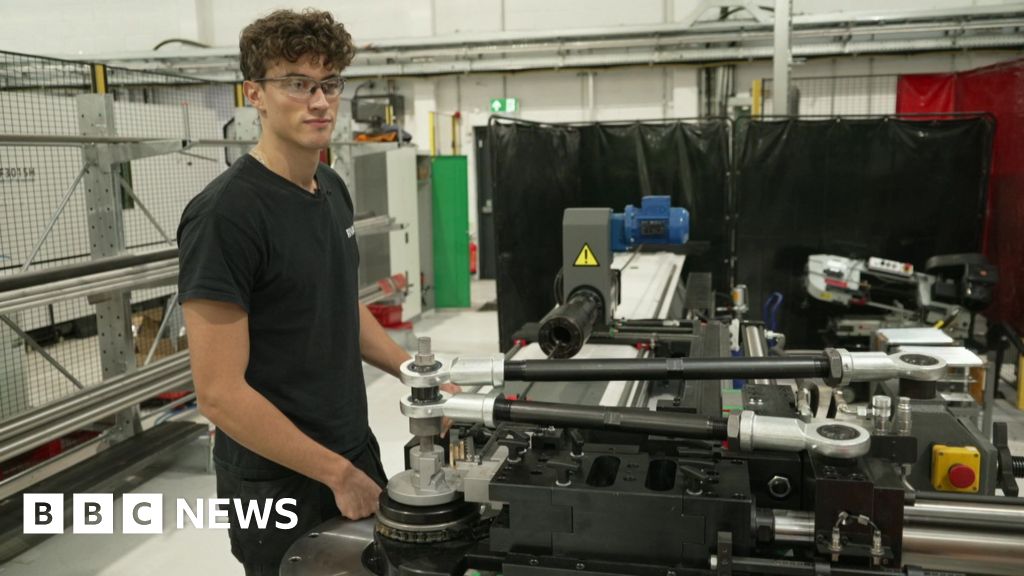
"We hire from end to end: mechanical, electrical, software engineers, aerospace engineers. "Then we go into manufacturing, so we have assembly, fabrication. "We also have commercial, financial, really, everything under the same roof in one big facility." Eoghan MacLeod is a CNC machinist working on a jet engine cover at Isembard Research and development engineer Rafe Dignan from south-west London graduated in 2024, never expecting he'd be able to get a job in his home city.
"I moved back in with my parents after uni," he says. "I thought I would have to move out to somewhere in the countryside, or one of the manufacturing hubs to get a job where I was actually able to use my hands and physically build things. "I came across Rivan and it's actually the perfect job." Senior research engineer Tim Johnson from Ealing spent 10 years working in Sheffield, but welcomed the opportunity to get back to the bright lights of London.
"It was really exciting to find an opportunity in London where I could use my practical engineering skill, and develop my career in the capital," he says. Rivan's chief executive Harvey Hodd is a former professional footballer who thinks investing in green energy is the way forward Senior engineer Tim Johnson from Ealing is enjoying being back in the capital after 10 years working away So is this the start of a new industrial revolution for London? Daniel Reast, senior researcher at the Centre For London, thinks that could be overstating it.
"What we are seeing is an evolution of what was really successful in London," he says. "Areas like this with sustainable fuel, advanced manufacturing, lab tech, life sciences, those are the kinds of things which make growth for London and the UK." The Centre For London's Daniel Reast believes this is the sign of an evolution not a revolution However, Karim Fatehi OBE, chief executive of the London Chamber of Commerce and Industry, says the two major factories opening in Southwark signals a "strong vote of confidence in London as a base for modern manufacturing". "It shows there is a future for high-value, technology-led industry in the capital," he says.
"London's skilled workforce, universities, investment and global connectivity give businesses a real competitive advantage. "Southwark also has a long industrial history, so this investment is a positive sign for the future of industry in inner London." Related internet links
Source: BBC